Events
Events annotate ranges of time in your data. They help you quickly identify, categorize, and search for relevant subsets of your data.
How events work
Events can be created manually in the app or programmatically via the API. You can use the API to create events on-robot or during post-processing. Events can be accessed in a few locations within the app:
- The visualization playback timeline
- The visualization Events sidebar
- The Events listing and search pages
- An Event details page with a unique URL

Events define a time range for a device. They may also include associated properties. Events that overlap with the time range in visualization will appear above the playback bar.
You can click "Visualize" in the Events listing to open visualization. This will include data for all recordings associated with that device that overlap with that time range. Select two or more events and choose Compare to open them together in Comparison mode. Use Shift to select a range of adjacent events.
Event types
Admins can create event types to define categories of events with structured properties. Each type includes a human-readable name, a color, and an ordered list of typed properties. Types and properties are managed from the Events page.
Properties support several types of values:
- Single-line text
- Multi-line text
- True/False
- Number
- Single-select
- Multi-select
Event types ensure data quality through validation. They also enable better filtering and analytics, and provide visual distinctions between categories of events.
Viewing and editing events
Seek to a point of interest in your data. Under the Events menu in the playback bar, click "Create event", or press Cmd+E. This will create a zero-duration event at the current playback position. Where you can also create episodes, the button is "Mark range", and Save as chooses whether the range becomes an event or an episode.
You can adjust event time ranges directly from the playback bar. The event being edited will also be highlighted in time series Plot and State Transitions panels. You can also view a list of all events in the right sidebar's "Events" tab.
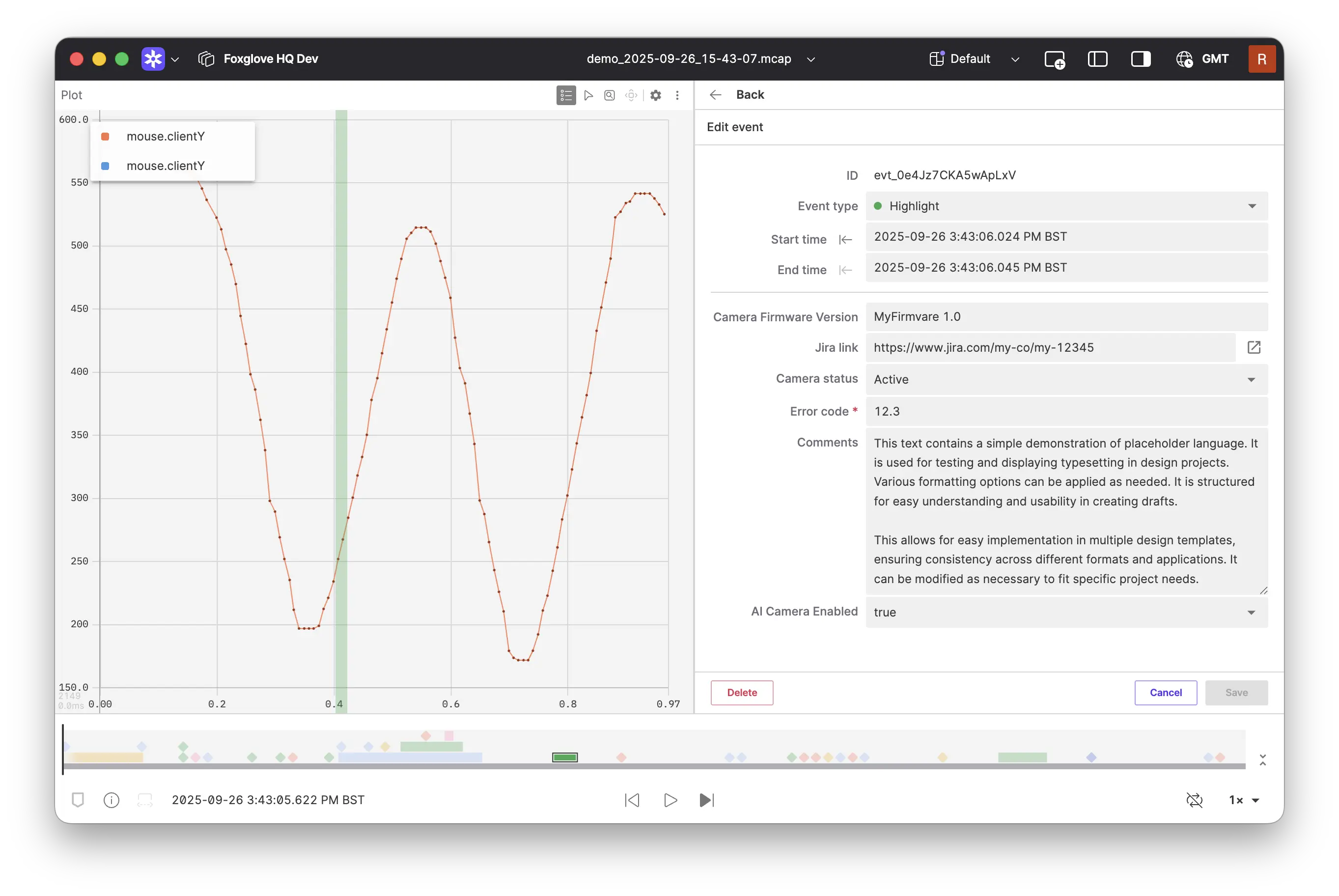
Use the current playback position marker and endpoint snapping to precisely align events with other data.
To edit an existing event, click it in the Events sidebar or in the timeline. While editing you can:
- Modify properties
- Adjust start and end times
- Change the event type
- Delete the event
You can select an event type from the dropdown. This will display a form for entering the event's properties as defined by organization administrators. Typed events are color-coded, making it easier to distinguish different categories of events.
Events in comparison mode
In Comparison mode, events appear on the shared timeline. Each event stays anchored to its source's timestamp, so adjusting a source's start offset shifts its events with it. Comparing across devices adds a device label to each event and disables creating and editing events.
Search
On the Events page and on a device's Events tab, a search box on the left of the filter bar matches one event by its full ID.
Press Cmd+F (Ctrl+F on Linux and Windows) to focus the search box. In a web browser, press it again while the box has focus to use the browser's find in page.
The Filter button opens the other filters. The filters available depend on your organization's plan and can include device, time range, event type (when your organization has event types), creator, and properties. The menu's search box matches filter names and values: typing 7 days offers Time range › Last 7 days. Press F to open the menu. Choosing a filter adds a chip. + adds another. Click a chip to edit it, or × to clear it.
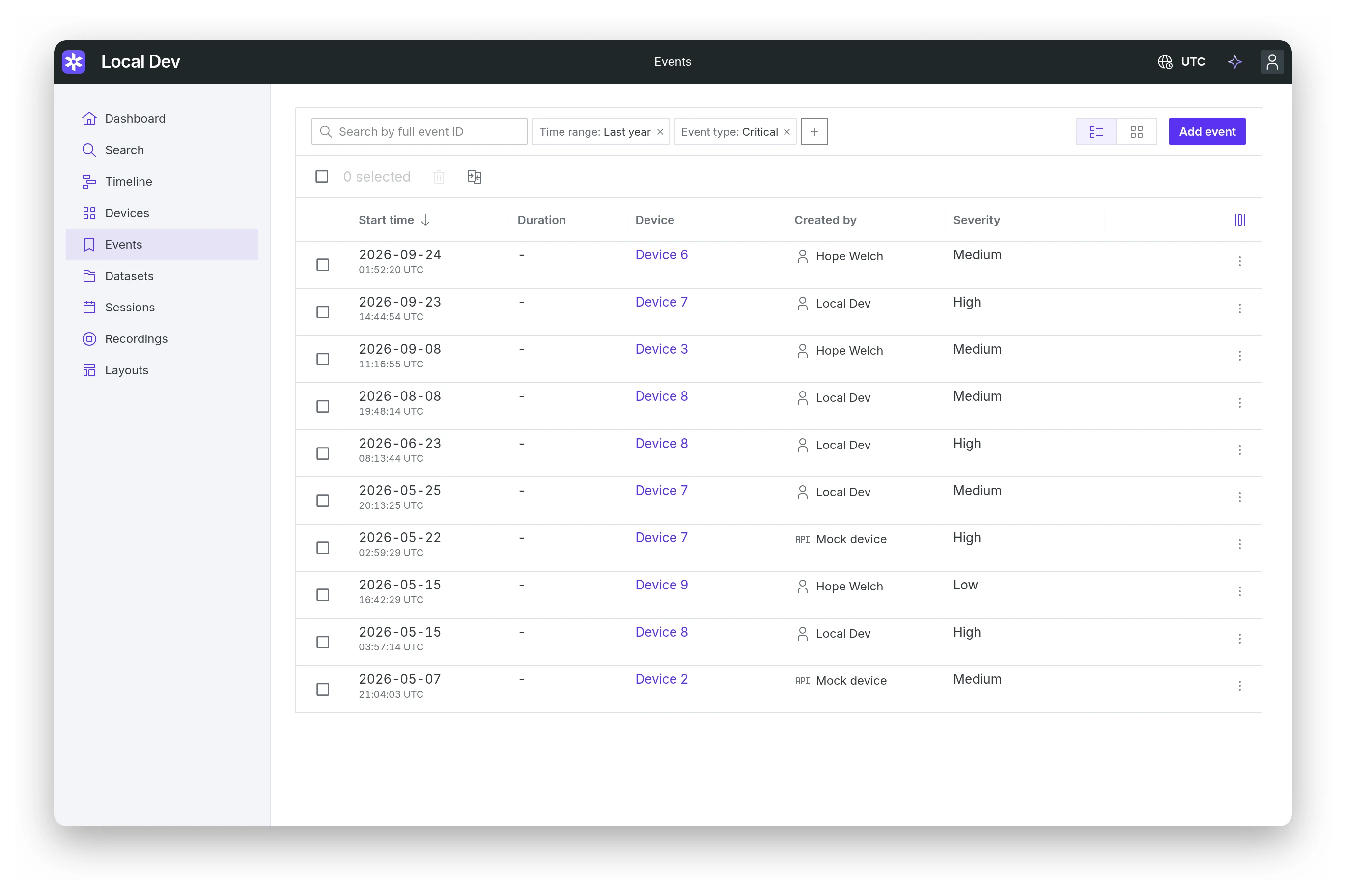
Use the syntax below to filter properties by keys and values:
| Specific key | Any key | |
|---|---|---|
| Specific value | weather:rain | *:rain |
| Any value | weather:* | |
| Multiple values (all required) | weather:rain weather:fog | |
| Multiple values (1+ required) | weather:rain,fog,"mostly sunny" |
A single word (for example, error) will look for matching keys or values.
Non-alphanumeric characters can be used inside quotes (for example, "/weather/rain":* or "@my.custom.key":"10%").
The dropdown selector within the metadata filter lets you choose whether the filtering applies to events with typed properties, events with untyped metadata or both. Selecting either typed or untyped is a faster query than filtering both kinds of properties.
Event types will also be displayed in the search results when present. Selecting a particular event type from the dropdown will filter the search results to only show events of that type, and display the properties linked to that type in individual columns.
Filter by creator
Filter events by who created them. Use the Creator email filter to find events created by a specific user, or the API key label filter to find events created programmatically with a given API key. These filters are mutually exclusive, since each event has a single creator.
The search results include a Created by column that shows each event's creator. A Created at column, which shows when the event was created, is also available from the column menu.
Deleting event types and custom properties
Administrators can delete event types and custom properties when they are no longer needed. These can also be deleted using an API key with the EventTypesDelete or CustomPropertiesDelete capability.
Deletion rules are designed to prevent data loss, or inconsistencies in your organization’s data:
Deleting event types
An event type can be permanently removed by deleting it. It cannot be deleted if there are any events of that type. You must first delete or update those events.
Once deleted, the same event type name can be reused to create a new event type.
Deleting custom properties
A custom property can be permanently removed by deleting it, if it is unused:
- It cannot be deleted if it is linked to an event type.
- It cannot be deleted if an event stores a value for that property.
Once deleted, the same custom property key and label can be reused to create a new custom property.