Recordings
Recordings represent every data file recorded by your organization's devices.
Import, delete, and filter recordings from the Recordings page:
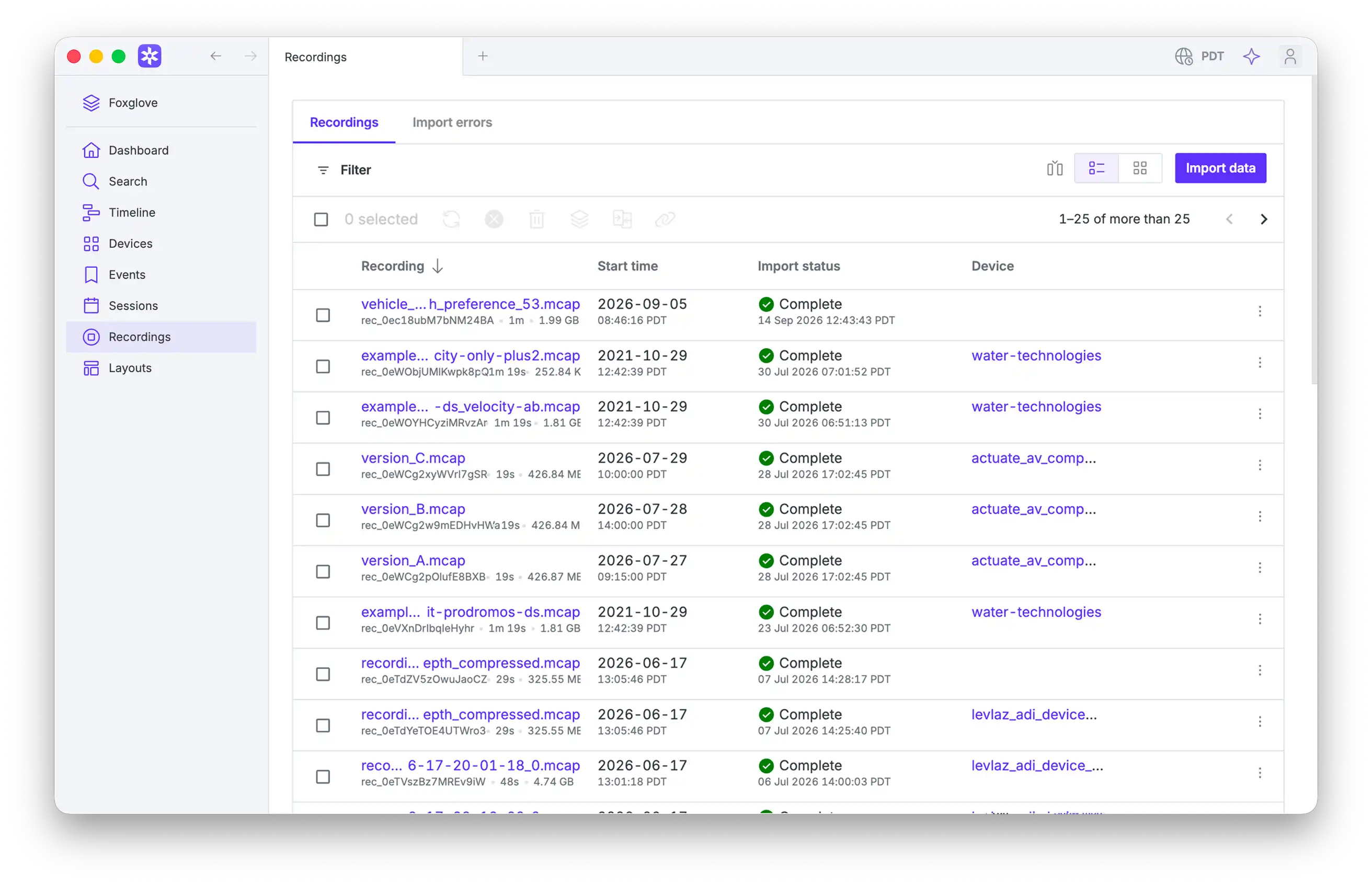
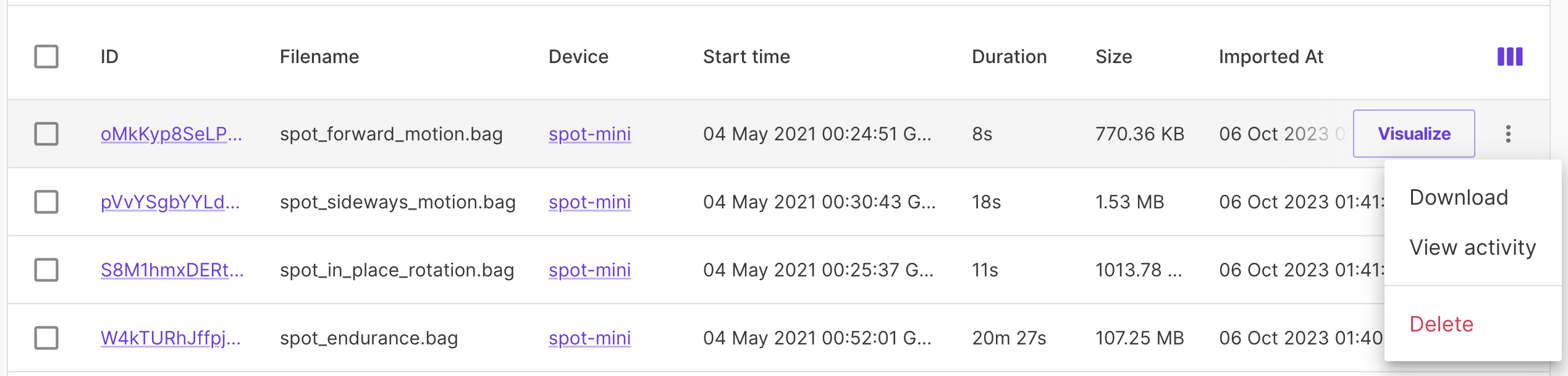
Hover over each recording to visualize it using Foxglove panels. Select two or more recordings and choose Compare to open them together in Comparison mode. Use Shift to select a range of adjacent recordings. Open the recording's "Actions" menu to delete it or to download it as an .mcap or .bag file:
Select specific time ranges of data to download from the Timeline page.
Actions
CLI examples below use v2. See the v2 migration guide when upgrading from v1.
| Definition | CLI command | |
|---|---|---|
| Upload | Upload a data recording for a device in your organization | foxglove upload ~/data/bags/gps.bag --device-id dev_drpLqjBZYUzus3gv |
| Delete | Delete a data recording imported into your organization | foxglove recordings delete rec_123 |
| Attach contextual data | Import MCAP files with metadata records | N/A |
| Attach auxiliary data | Import MCAP files with attachments | N/A |
| Download | Download a data recording as an MCAP or ROS 1 .bag file | foxglove export --recording-id rec_123 --output-file output.mcap |
MCAP is the default export format. Use --output-format bag1 for a ROS 1 bag or --topics /gps/fix,/gps/fix_velocity to select topics. Use --output-file so the CLI can recover interrupted MCAP and ROS 1 bag downloads and preserve an existing destination file if the download fails.
Deleting a recording
Deleting a recording also removes its data. If the recording is in a session, it no longer appears there after deletion.
If the recording was imported from an Edge Site, only that imported data is removed from Foxglove; the edge copy on the Edge Site is unchanged, and the recording will stay in the table listed as "Not imported". In that case the recording stays in its session, and re-importing restores it there.
For bring your own storage, delete the file in your bucket; Foxglove removes it from the index when the file is gone. If the recording is in a session, it no longer appears there once removed from the index. The Recordings page delete action does not delete those files.
Filtering
On the Recordings page, a search box on the left of the filter bar matches recordings by name or ID. Its dropdown chooses the field:
- Name matches part of the file name, ignoring case. Enter at least 3 characters.
- ID matches one recording by its full ID.
Press Cmd+F (Ctrl+F on Linux and Windows) to focus the search box. In a web browser, press it again while the box has focus to use the browser's find in page.
The Filter button opens the other filters. The menu's search box matches filter names and values: typing 7 days offers Time range › Last 7 days. Press F to open the menu. Choosing a filter adds a chip. + adds another. Click a chip to edit it, or × to clear it. When both a name and an ID are set, the one that isn't in the search box appears as a chip.
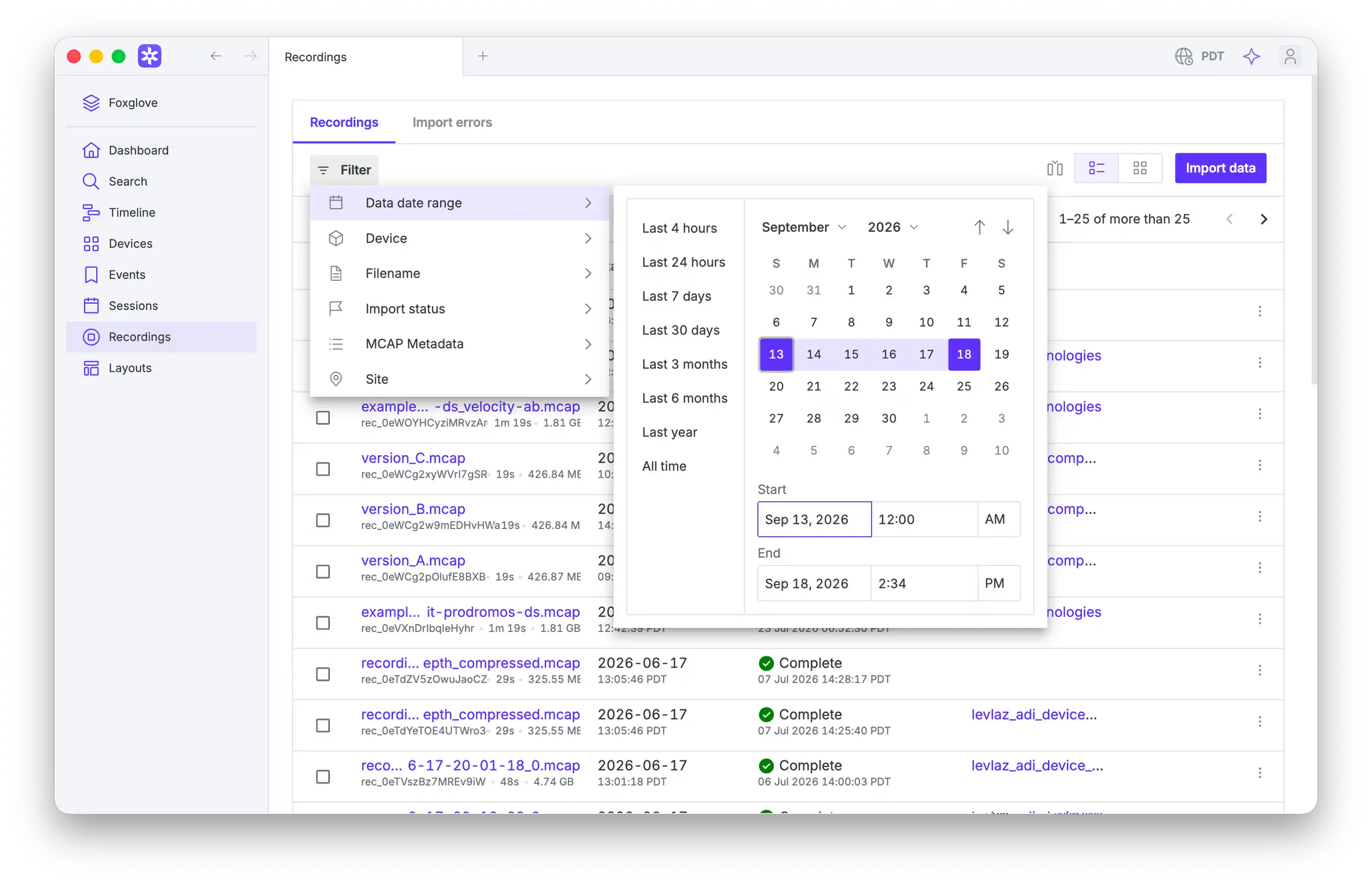
The filters available depend on your organization's plan and deployment, and can include:
- Time range — limit to a rolling window (for example, Last 7 days) or a custom start and end
- Device — restrict to a single device
- Import status — filter by import state: Not imported, Pending, Importing, Complete, or Failed (deployments with search also include indexing states)
- MCAP Metadata — query the metadata keys and values recorded in each file (see the syntax below)
- Recording key — match recordings whose key contains the text, ignoring case (keys that Foxglove generates on upload never match)
- Session ID — restrict to the recordings in one session, by its exact ID (shown on plans with sessions)
- Site — restrict to a specific primary or edge site (shown when your organization has more than one)
MCAP Metadata syntax
Use the syntax below to filter by metadata keys and values that were in the MCAP metadata records.
| Specific key | Any key | |
|---|---|---|
| Specific value | weather:rain | *:rain |
| Any value | weather:* | |
| Multiple values (all required) | weather:rain weather:fog | |
| Multiple values (1+ required) | weather:rain,fog,"mostly sunny" |
A single word (e.g. error) will look for matching metadata keys OR values.
Non-alphanumeric characters can be used inside quotes (e.g. "/weather/rain":* or "@my.custom.key":"10%").
Note: Recordings with total MCAP metadata size of > 1 MB do not show up in this search.